Showing posts with label Q and A. Show all posts

Wednesday, October 26, 2011

Summer School 2012 interview series: Rick Rudd

Kyla Mackenzie interviews award winning studio potter Rick Rudd in the lead-up to his Summer School class Hand Built Pottary in January 2012. Click here for a full description of Rick’s class & enrolment details.


KM: You trained in England and have, since arriving here in 1973, exhibited extensively here and overseas and have featured in many publications.  


Given your extensive experience as a pottery tutor,  having taught since 1981 – what do you look forward to with the upcoming course at Corban Estate Art Centre?


RR: I really enjoy the concentration necessary of shorter courses, the level of focus required, the adrenalin...  I want the students to milk me for as much information as possible...In fact, I'll know I haven't done a good job if I'm not drained at the end of the course!


KM: What do you enjoy most about teaching others? 


RR: It is very satisfying engaging with different personalities and adapting to different needs at each course.  Are they novice or  experienced?  It doesn't matter.  The challenge of each situation keeps tutoring fresh for me as each atmosphere is new and I therefore demonstrate in a different way.


KM: Do you gain perspective on your own work while teaching?


RR: While I like working on my own, you always gain ideas during workshops – they can really spark things off for me.  


KM: Over the course of 5 days, you'll be teaching students your techniques of pinching and coiling.  What will the students gain from these methods?


RR: Any shape is possible with this process – you can have very rounded forms to the very angular; they can look 'thrown' or look 'slab built'. A great advantage is that the forms don't have structural weaknesses – and that the method allows large scale objects to be made – building up from the bottom.  


KM: I understand that as a young student, you discovered your facility with clay despite being enrolled on a textiles course?


RR: I discovered I don't think in 2D during my Textiles course...After 2 or 3 months I went downstairs to the pottery class one evening and worked with clay for the first time.  I finally twigged.  'Clay was the Way'.  Therefore, while I had hated life drawing, I later loved making torsos out of clay.


Later when working with clay, I resorted to doing 'working' drawings after the objects were done – which was probably obvious to the tutors!


KM: Were there other moments or experiences that helped you along the way?


RR: I developed an appreciation for the Oriental aesthetic.  However, it took two trips in 1995 and 1997 to Japan for the penny to really drop. I marvelled at the pottery tradition in Japan and Japanese aesthetic, ...their talents and importance.  


In fact I have a large collection of Japanese drinking vessels  - I loaned them to Objectspace recently – 100 works collected over several years.  


KM: Were there individual practitioners who inspired you along the way?


RR: There were two strands of influence for me – the Modernist was one - Lucie Rie, a Viennese potter who left Nazi Germany to live in London, and Hans Coper who she mentored and then worked alongside, were my gods.  Function informed the shapes, but the resulting object was very much an aesthetic object.  The sculpture of Henry Moore and Barbara Hepworth was also very formative.  I went down to London to a wonderful Henry Moore exhibition when I was still living in England. 


The other strand was represented by the domesticware of important British studio potter Bernard Leach who launched an Anglo/Japanese tradition with Japanese potter Hamada.  

Rustic simplicity was key.  


KM: And now?  


RR: I've been around so long, it's now a matter of my own work influencing me.  I go back and forwards – returning to ideas and re-developing forms in different directions.  


KM: Does function play much of a role as opposed to aesthetic considerations in your work?


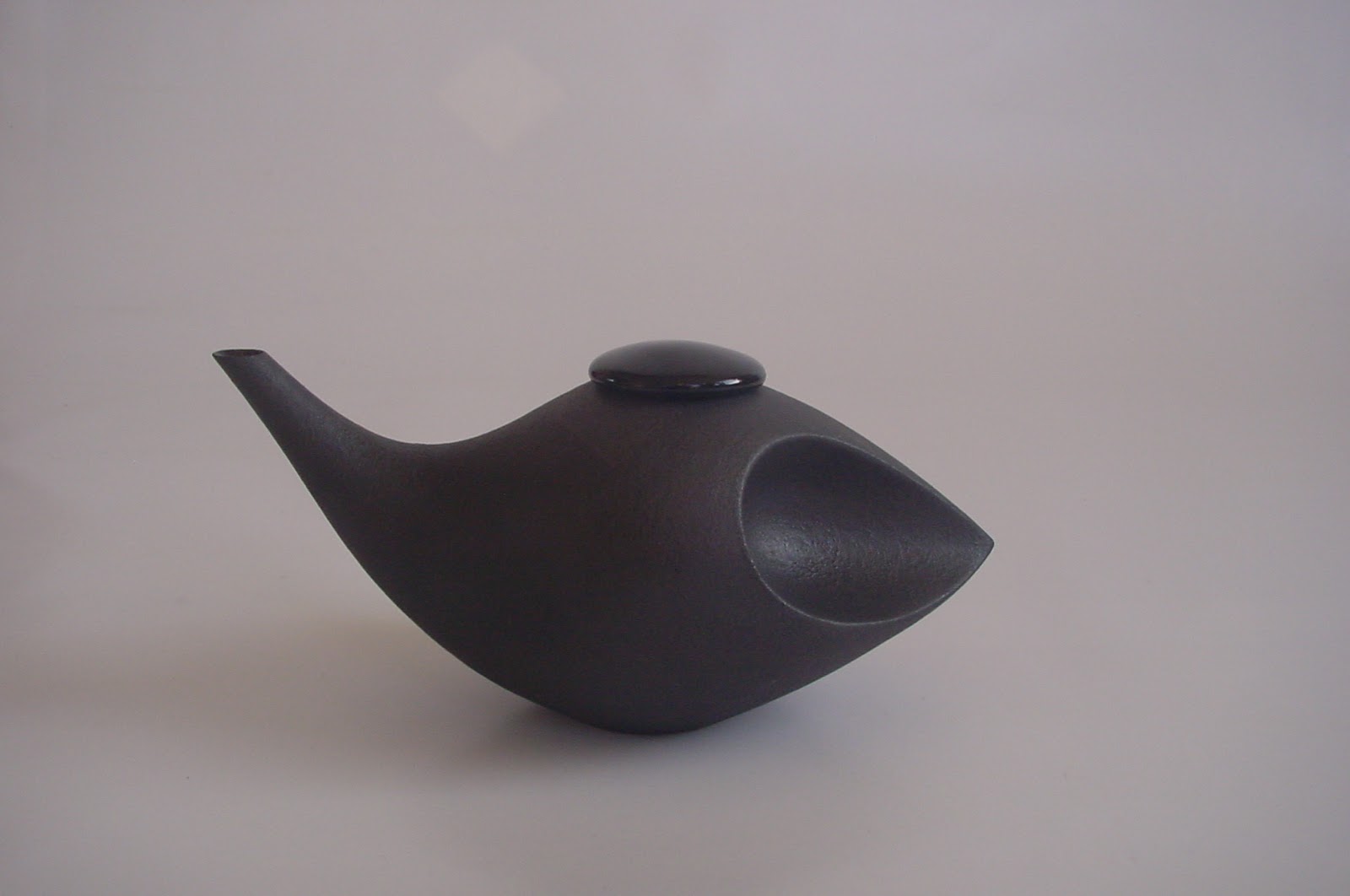
RR: The teapot, for example, is an easy entry point for people.  They know what a teapot is.  A teapot of mine doesn't pour and well, it's impossible to get a teabag in... For me, it's all about form.  


KM: Your works that I saw recently are suggestively figurative, lively and playful – what are some of your visual stimuli?


RR: People see all sorts of things in my work.  It's just a form but that's ok.  People even see mountains... I never put titles on my pieces.  The shapes, line and form are suggestive of anthroporphism at times.


KM: What are your thoughts on pottery today? 


RR: There are fewer full-time potters.  Many of the existing potters went off and got 'real jobs' when cheap imports came in in the 1980s.  The 70's was the heyday – anyone could make pottery and sell it.  Now there is a discerning public and that's good.  It's healthy not to have an oversupply and more important to get quality.  


Now you get more part-time potters – who I would not call hobbyists – they are often just as professional as the full-time potters.  


KM: Why do you prefer to be called a studio potter rather than ceramicist?


RR: In the 1980s, you could go and do 'hobby ceramics' – and someone else would fire your pieces.  It was somewhat 'by numbers'.  To me, 'ceramicist', still smacks of that scenario.


The 'studio potter' makes one-off pieces so I use that description.  


KM: What are your thoughts on the status of New Zealand pottery/ceramics?  


RR: I think we punch above our weight, given our population size.  These days influence and ideas can go round the world in 5 seconds with the internet.  We're not so isolated any more.  
It never worries me when people copy or take ideas from my work.  Everyone's got to start somewhere in order to move onto something else...


Summer School 2012 interview series: Beck Wheeler


“I think art and play should be the same thing.”


CEAC staff member Kyla Mackenzie interviews Beck Wheeler in the lead-up to her Mixed Media Summer School class in January 2012. Click here for a full description of Beck’s class & enrolment details.


KM: Beck, in 2008 you were named one of Australia’s Top Ten Creative’s by Design Quarterly, you exhibit internationally (Japan, UK, USA, Australia, Spain and New Zealand) and now back in West Auckland, New Zealand, you are offering an exciting workshop at our 2012 Summer School:  


Did you ever dream you could have a career using your imagination and immense sense of play?


BW: I always wanted to be an artist, but when I was younger I didn't know how to become an artist. I thought it might be something that just magically happened. 


I got stuck in art school for awhile. I found art school quite conservative, instead of inspired I felt very confined. At art school if you weren't doing minimalist text based paintings or conceptual installation you failed. 


It took me a few years away from art school before I started to embrace my creativity again. I looked at the things I collected and the things I loved for inspiration. I learnt to paint in every medium available, I learnt ceramics, textiles and a variety of sculptural techniques. I allowed myself to play and make mistakes. And then 10 years later I realised I was making a living full time as an artist. 


KM: Your course offers the student the creative environment in which to create visual narratives using paint and found objects:  how will you guide the class to mine their personal memories for this purpose?


BW: Our minds are a great big filing cabinet filled with our memories and experiences. Maybe you want to do an artwork about a childhood memory, or maybe you want to do an artwork about your morning walk to the dairy.


I think art is about being honest with yourself. What excites you about art/life, might not excite someone else. There are no right and wrong answers, its very personal. 


Everyone has things they have collected, things they love, colours they are drawn to. 
I think the key to keeping creativity alive is to identify the things that excite you. Then not to judge these things as being either good, bad or ugly.


KM: What should they bring?


BW: You will need to bring in the materials on the materials list, which includes acrylic paint and brushes. Additional materials to bring in will be discussed on the first day of the course. This might be reference material, family photos, paper for collage, or objects that you want to work with. We will be working predominately with acrylic paint, however we will discuss how to work in mixed media. A limited amount of inks and watercolours will be available to experiment with. If you have your own watercolours or inks you are welcome to bring them in.


KM: What are some of the sorts of found objects you yourself have found evocative in your own works?  


BW: I am drawn to domestic objects. I use old kitchen utensils, broken childrens toys and all sorts of random odds and ends. I work mainly in wood and plastic.


KM: You provide some understanding of colour theory in the workshop – what are some of the emotional resonances and perceptual effects that you find particularly compelling?


BW: In my own work I try to use the brightest colours I can find. I will use one bright colour and then I will find or make its opposite (relating to the colour wheel). I am inspired by how you can create harmony in an artwork through the use of opposing/complementary colours. Even when you are using a very colourful palette you can still create harmony and balance.


Colour also has the ability to communicate without words. I love how passionate people get about a colour, or a palette of colours.  If you want to see how passionately geeky you can get about colour palettes then head to www.colourlovers.com This website is where people can go to upload their favourite colour combinations it has 1,815,625 different colour combos uploaded so far.


KM: What textures and colours from your own childhood memory have informed your own work?  


BW: I was bought up in the late 1970's and a lot of my childhood books and toys were in citrus greens and oranges with splashes of hot pink and muted shades of blues and browns. I am  definitely drawn instinctively to using a similar colour palette in my work.


The textures and patterns I use developed as I experience different cultures and environments. I use a lot of textures from the bush since moving to Piha, but when I was living in the city I tended to use more geometric forms.
  
KM: Childhood or references to are often delightfully universal in much of your own work:  do you think we should actively embrace ‘the child’ within?  


BW: I think childhood themes are popular because they remind us of a time when it was okay to play. In play there is no right or wrong. But as we grow older we start to analyse everything in terms of being right/wrong good/bad and we lose the freedom of play. 


I think art should embrace play. I think art and play should be the same thing.


KM: How important is play, fun and beauty for our mental health?


BW: I think play and fun are very important to our mental state.


KM: Who are some of the artists who have inspired your art and philosophy along the way?  


BW: Edward Gorey, Jon Pylypchuk, Quentin Blake, Chris Ware, Winsor McCay, Shaun Tan, William Morris, Richard Kearney, Bosch, Brian Boyd


KM: What do you look forward to most about your upcoming Summer School workshop?


BW: Sharing knowledge: I am passionate about art materials and using traditional painting techniques in a contemporary way.


Empowering creativity: I think everybody is creative, but we just get trained out of it as we grow older. I think it is important to get the creative juices flowing.

Monday, July 11, 2011

Q &A with New Art Tutor Kathryn Stevens

Kathryn Stevens


'Pulse', 1200 x 1000mm oil on canvas 2010


Viewfinder at bath st 2008


“Painting ... is just so... open and endless. Painting can be anything that you want it to be."

Kyla Mackenzie interviews CEAC's new tutor Kathryn Stevens in the lead-up to her Adult Art Classes in August. Click HERE for the full class descriptions and enrolment details.

KM: You will be launching a new beginners 6 week art class at Corban Estate Art Centre from 17 August to 21st September; after 10 years of teaching painting and drawing, what are some of things that you enjoy most about teaching others?

KS: The thing I enjoy most is students surprising themselves, both in what they can achieve and in how much fun they can have in the process.

KM: What do you start with first when teaching beginners?

KS: I start very much at the beginning, with building practical drawing skills, learning to really look at whatever it is you are drawing, and gaining trust in your creative process.

KM: You like your students to loosen up and play; what are some of the exercises you teach to allow the creative process to flow?

KS: I think that creative flow is about engaging with painting in a curious way so I like to work on developing that curiosity. To approach painting with a desire to find out ‘what happens if...’

KM: What are the best ways to overcome painter’s or artist’s ‘block’?

KS: New materials or even just a new paint colour can change the game enough to get the ideas going again.

KS: The most important thing though is to just keep showing up and doing the work regardless of, in fact especially, if you have that feeling that you aren’t getting anywhere. Working always generates the inspiration and ideas not the other way around.

KM: Are there other areas of ‘play’ or hobbies that you enjoy?

KS: Making things with my seven year old daughter, cardboard, glue, paint etc...

Learning anything new.

Yoga

Gardening, I like to keep a vege garden and even when I don’t get much time in it I love the fact that it is growing and I can walk out and pick something to add to a meal.

KM: What are some good working habits for artists to learn?

KS: To make time and space for your art making and then just stick to it.

KM: What value do you place on the creative process for a person’s overall happiness?

KS: Being creatively active is normal and essential and benefits us in most areas of our lives. People are usually happier, more stimulated and better to be around when they are creatively engaged.

KM: What was the catalyst or catalysts for your own foray into art making? You began with engineering..., so what made you change tack?

KS: My studying engineering was largely as a result of being directed (at School) in an academic direction, and at that time that was to the exclusion of art. I guess the catalyst for the change was pretty much dissatisfaction and a determination to find my right place.

KM: You’re also a make-up artist for the fashion and advertising worlds – do you find there’s any overlap between the layers of colour and texture that you play with in both fields?

KS: I guess there is but they never seem linked to me. Painting for me is just so much more open and endless. Painting can be anything that you want it to be. Everything about my painting is driven and evolved by me and that makes it ultimately challenging and rewarding.

KM: What are you looking forward to most with this new course at Corban Estate Art Centre?

KS: I just love starting people off on the journey of painting, and showing them that they can do it!


Tuesday, November 16, 2010

Summer School Tutor Interview Series - Bridget Brandon


CEAC staff member Kyla Mackenzie interviews Bridget Brandon in the lead-up to her Summer School class ‘Igniting the Creative Fire of Writing’ in January 2011. Click HERE for a full description of Bridgets' class & enrolment details.


KM: Your upcoming writing course in January Igniting the Creative Fire of Writing revolves around each participant's own life story. Is this focus on understanding one's own life, a crucial step for meaningful writing of any kind?

BB: I feel the core of my work is about creating the platform for individuals to dive into themselves and at the same time into their creativity...It seems we have a lot of hang ups about our writing in particular. In addition people think their life is ordinary and they can’t express themselves. Given the right circumstances and encouragement most people are creative.

KM: A previous student of yours said:
“I feel that 'writing' my life is also like 'righting' my life - setting it out before me, so I can look at and understand the reason for decisions I have made throughout the years I have been writing about.” (http://storyworks.com.au) Is this a common experience for your students?

BB: Yes it is!

My goal is to allow people to see their life is not ordinary. No ones life is ordinary. (It is) quite the opposite and telling their stories and having their stories listened to in a non judgemental way allows them to appreciate the uniqueness of their life. With the feedback I focus on what works and I get the group to provide feedback on what works. Once someone is feeling confident, sometimes then I introduce the element of what else or what if...

KM: What is an example of one of your ‘loosening up’ exercises to get thoughts and memories flowing?

BB: One example is to draw a word out of a hat and write about what it means for 5 minutes.
Another is to choose a colour and then keep observing where you see that colour and next day write for 10 minutes on that colour.

KM: What's an example of a writing discipline you get your students to use?

BB: Just do it, just have a go. Early on I give out 5 writing principles. These really help people deal with their critic and issues. Each day they choose one to work with and at the end of the day we check in to see how they have gone. So the key is active engagement and not letting them get away with saying they can’t do it.

…. Focus on the story and the words will follow whereas if you focus on the words paraylsis sets in and the story is lost.

An excerpt below is written by someone who I think sums up my approach:


I arrived at the Larapinta River without a story in my mind and no idea whether I would actually be able to write anything. I have never had any confidence about writing and this was my first experience of putting my stories onto paper. The week was full of insights, friendship, grace and fun. Thinking about what made it possible for me to get so much out of it. Here are some thoughts.

The written hints we were given (eg the Basic Prinicples/ Seven Rules//Haiku guidelines) were sufficient to give practical help and to set a tone of freedom without being prescriptive (ie that there was a "correct" way to write and a benchmark to achieve).

No activity went for too long - most of the exercises were quite short in duration and I had a sense that even if I wasn't sure I was "on task" it didn't matter as the time spent doing it was limited and the next task would come along shortly. I didn't have time to "get stuck".

The reading back to the group was great - it gave me a sense of each person's uniqueness and that there were a lot of different ways of approaching a task - all of which were valid and which, therefore, validated my own voice/expression.

The fact that it was compulsory to read aloud was important - it helped to know that you "could run but you couldn't hide"(as it were). At some point you had to put into voice the words written on the page.

I arrived at the Larapinta River without a story in my mind and no idea whether I would actually be able to write anything. I have never had any confidence about writing and this was my first experience of putting my stories onto paper. The week was full of insights, friendship, grace and fun. Thinking about what made it possible for me to get so much out of it. Here are some thoughts.

The written hints we were given (eg the Basic Principles/ Seven Rules/Haiku guidelines) were sufficient to give practical help and to set a tone of freedom without being prescriptive (ie that there was a "correct" way to write and a benchmark to achieve).

No activity went for too long - most of the exercises were quite short in duration and I had a sense that even if I wasn't sure I was "on task" it didn't matter as the time spent doing it was limited and the next task would come along shortly. I didn't have time to "get stuck".

The reading back to the group was great - it gave me a sense of each person's uniqueness and that there were a lot of different ways of approaching a task - all of which were valid and which, therefore, validated my own voice/expression.

The fact that it was compulsory to read aloud was important - it helped to know that you "could run but you couldn't hide"(as it were). At some point you had to put into voice the words written on the page.

I did find that once my secrets became stories they were set free. There was an alchemy that took place. The stories still belonged to me but they didn't have the same grip on me as before. They became things to respect as the experiences that had shaped me and I didn't feel scared that people would judge me.

Telling my stories allowed my light to shine. Active listening was important - you knew that at the end of your reading there would be comments which kept me grounded in the experience (not able to quickly slam the book and pretend it had never happened).

Working with metaphor was really useful. It was helpful to step outside my own reality and to use the language of "tree/landscape/nature" to write more evocatively. It allowed me to experiment with language and to look at situations from a different perspective.

The process of rewriting the "hard" situation using the language of the landscape was particularly helpful. It changed the language and tone of the story completely and that was a revelation to me.

The process of drawing the life scheme (rapids/billabongs/flowing) was very useful. To then take a "chapter" and break it down into "moments" made it easy to approach the story. It also allowed me to see how rich each of those "chapters" was and that there was a wealth of material for stories. I felt proud of my life when I thought of it like that - such a rich life!!

The consistency around the time keeping was good. Knowing that there was a set time to complete a task and that we would be kept to that made it possible to concentrate on the task at hand - your instruction to "find a way to finish the sentence" meant that the task didn't "bleed" into the time available.

The clarity of instructions and permission to take the task wherever it wanted to go. It meant there was both structure and freedom.

Bridget’s management of the "subtle “level to the group was masterful. Especially on the morning that Paul left - you brought us back to a a more centred space. You did this by naming the tension that was in the group and by asking us to renew our commitment to the process.

Having all the logistics taken care of was fantastic - it freed me to concentrate on the tasks at hand - no distractions and no rushing to ensure that I was on time for tasks - I was free to chill out and follow my own thoughts.
~ Participant 2005

Tuesday, September 14, 2010

Summer School Tutor Interview Series - James Moore

James Moore


'Untitled' 2009 - 2010

CEAC staff member Kyla Mackenzie interviews James Moore in the lead-up to his Summer School class ‘Drawing Beyond the Boundaries’ in January 2011. Click HERE for a full description of James's class & enrolment details.

KM: You are holding a three day workshop, Drawing Beyond the Boundaries, 18 – 20 January 2011, at Corban Estate Art Centre in Henderson. How would you describe your approach to drawing in this class?

JM: It’s a broad and explorative approach, covering a wide range of media, techniques and perspectives on the notion of drawing.

KM: Paint is used in this class and you have taught both painting and drawing for 15 years. Are drawing and painting as categories in art potentially confusing?

JM: Categories of drawing and painting may have a large area of overlap. Rather than being confusing it just means that the categories shouldn’t be seen as being too separate. If I make a preparatory study in painted line then it can be a drawing and a painting.

KM: What do you love about teaching art?

JM: It is really satisfying to see students make progress in their work. It is powerful to help instill and support the self belief that students need to make keep making art.

KM: Is it hard to find the time for your own art?

JM: Yes. Sometimes. It can be frustrating to have the ideas and motivation but have other commitments keeping me from getting in to the studio… It’s a matter of grabbing the windows of opportunity when they come along and hope the opportunities coincide with some inspiration.

KM: I have asked painter Viki Garden if she considers painting to be “... a difficult pleasure”. Is a certain amount of struggle simply part of the creative process?

JM: Yes. I would describe it as a difficult pleasure. I generally run into problems in a painting sooner or later even with things quite well planned before hand. Problem solving is a big part of the art making process. A lot of people want to believe that it’s all feverish emotional outpouring and soul bearing split by a lightning bolt of inspiration.

KM: Some of your own work is montage-like. Objects are placed together within the frame creating intriguing combinations. Could you describe them as ‘picture-poems’?

JM: Yes in the sense that the combinations of elements in my work do not necessarily have literal narrative connections. They resonate in more oblique ways so yes it’s more like poetry than prose I guess.

KM: What are some of the things around you that inspire your own work?

JM: I’m interested in certain elements of popular culture at the moment. Computer games, still-frames from T.V. dramas, urban street art, street signage, shopping mall interiors.

KM: Do you keep a work book/diary with ideas on you?

JM: Yes. I have always kept a visual diary and encourage my students to do the same. It’s good to have your thoughts, doodles and pictures collated in one place.

KM: You’re also a musician. Does this have any influence on your visual art?

JM: Music and art work separately for me. When I am not teaching I am either doing a music project or painting project but generally not both. I feel I absolutely need to be doing both music and visual art and they complement each other rather than one being a direct influence on the other.

KM: Who are some of the artists, historical or contemporary, who inspire you?

JM: James Ensor, Francis Picabia, Anette Messager, Alex Katz, Neo Rauch, David Salle, Martin Kippenberger, Sigmar Polke, Bill Hammond, Andrew McLeod, John Pule, Joanna Margeret Paul, Julie Mehretu, Beatrize Milhazes.

Tuesday, September 7, 2010

Summer School 2011 Tutor Interview Series - Viky Garden

'New World Virtues' 2007
Oil/acrylic on jute
83.5 x 63.5cm


CEAC staff member Kyla Mackenzie interviews Viky Garden in the lead-up to her Summer School class ‘It’s All About You’ in January 2011. Click HERE for a full description of Viky's class & enrolment details.

KM: How long has your work been preoccupied with autobiographical element and the
figure – referenced from yourself?

VG: There’s a self portrait on my wall that was in my fifth form art folder – that’s
going back almost 35 years now….

KM: Your recent works, from 2009 and 2010 are quite different in effect. Rather than frontal portraits with exaggerated features, in the works from ‘nature/nurture’, a young girlish figure in black-silhouetted profile features in various allegorical scenarios. Did anything in particular spur this approach?

VG: I’m forever noting things in my workbook, drawing compositional sketches etc., because I’m always looking for new ways to represent the figurative within a narrative context. When I drew the silhouette, I knew that it would add more abstraction and ambiguity (even though it’s still my profile). The initial idea came from a profile in Arabesque (2006), which I adapted into the Passenger series (2009). While playing with ideas for Nature/Nurture (2010), I drew inspiration from the Pahiatua girls from Any Given Day (2002). I enjoy having a large body of work that I can constantly reference, and from which develop a unique language and individual set of motifs.

Private collection
'Self Portrait - Some trace of her' 2009
Oil/acrylic on hessian
800 x 600mm


Huia I
oil/acrylic on linen
50 x 70cm

KM: You have explored younger 'selves' previously in self-portraiture, such as ‘Seven”. What does ‘girlhood’ mean for you?

VG: It’s a very, very vulnerable time, a time of absorbing and grasping ideas, of
innocence and fragility. In Nature/Nurture, I have been exploring notions of merit and value, juxtaposing youthful innocence against the implicit presence of societal violence and sexualisation, so it was crucial to use a very young protagonist for this series to give emphasis to vulnerability, impressionability and the potential for corruptibility.

KM: What do red lipsticked lips mean for you?


VG: Lipstick is face-paint, a feminine tool. I use it in a number of ways, partly to
convey or accentuate sadness, irony, and artifice, but also to suggest individual projection and power.

KM: Familiarity breeds contempt, as the saying goes. Does this have any relevance to
your own repeated use of your face and body in your works?

VG: Not at all. If an idea is strong, I’m like a bull at a gate. It’s more about how to use her than me.

With regard to her. I start a composition that has a portraiture element to it -
I include myself within the context of the narrative. In the process of doing that, the portrait becomes more a figurative element, a slight disassociation that somehow allows both intimate reference (subjective 'the me') but also universal resonance (objective 'the her'). Which is why when other women (in particular) when viewing a painting, often see themselves.
I don't think they're buying a portrait of me. I've
had experiences (one in particular) where two women came to one of my shows and one woman broke down in front of a painting. It wasn't because she saw me, she saw herself.

All the paintings become 'my girls' - when I see a work I've not seen for a while, I
think, god, isn't she lovely!

KM: I've heard that 'good' models are hard to find. The artist's face is often the most convenient subject and talking to yourself is optional... Do you ever get asked to produce portraits of others?

VG: Talking to myself is mandatory, not optional. I have been asked to paint
commissions, however, painting someone else would mean interrupting a process that I have worked at for nearly twenty years. When I am painting, my mind is already working out how to move and expand (or reduce) the idea – so I’m already prepping the next canvas in my head and have worked in this way for years now - very much to the exclusion of all else. I’m rather protective of the way I work because ideas are fragile things and often the strength of a body of work is in the continuation of various thematic threads. It is very difficult to apply or impose these personal thematic strains on someone else, someone with their own set of expectations.

KM: You have gained a strong following, particularly over the last decade, and your
works have a depth, truth and integrity. Is painting for you, as Australian painter Brett Whitely put it, ‘a difficult pleasure’?

VG: Very much. It’s a difficult pleasure on various levels. I live in a city that
has a high cost of living and I paint full time, so I’m dependent on my work selling. The compromised lifestyle isn’t something I’d recommend in a hurry – not when you consider that inspired work has to come from it. Facing a blank canvas is daunting enough, then comes the time - the very alone time – of creating art. When it works, it’s a moment of personal celebration.

KM: As a young painter, you were tutored by another painter, Vivian Lynn. She later
became Lecturer of Drawing and Design, Schools of Architecture and Design, Victoria University. Did anything about her approach encourage your own hard edged painting style or did that evolve much later?

VG: Vivian tutored me for five years during my mid-teens. I am immensely grateful
for that time with her. They were formative years and I was in the best of hands. Her dedicated, disciplined and focused approach is a constant inspiration to me. An artist for nearly sixty years, Vivian’s work is as topical, relevant and vital as when I first met her. I began painting when I was 27 and my practice is drawn primarily from my time with her.

KM: Who are some artists and or artworks that have impacted on you and your work in
some way?

VG: Many artists and artworks have stopped me in my tracks. Shani Rhys James is a Welsh painter who also uses herself within a narrative framework. Marianne Kolb paints dark figurative studies that I sense are autobiographical. I’m also very passionate about the work of Ben Nicholson and Paul Nash. Their work has a high level of emotional intelligence, more feminine in expression than masculine. The sculptural work of Beth Cavener Stichter is inspiring. Another artist who greatly impresses me is Valerio Adami. My work is vastly different to his, but I completely understand his use of line and colour. His sense of composition is flawless.

KM: How do you recognise long-term potential and drive in the work of students and
emerging artists?

VG: If someone is able to articulate thoughts visually, devoid of superficiality
(unless that’s their intent and they express it well), then that’s a good place to start. Much depends upon motivation, discipline, good fortune and good timing. I am very interested in subtext (which I apply to my own work), and I look for it in the work of others. I’m attracted to art with conceptual depth, a sense of mystery and modesty – these are a few of the things I look for that speak to me about the inherent individual quality of an artist.

KM: Your paintings are instantly recognizable as yours. How do you encourage others painting their self-portraits to find their own iconography and painting style?

VG: I think if I can get others to feel relaxed with what they are trying to do, then
something will come of it – perhaps not even in the week that we have together. That’s fine. The pressure can be immense, a blank canvas can be intimidating, let alone a mirror in unflattering light. I simply want students to realize that painting is a process, and that observing oneself for long periods can be very rewarding.

KM: What are your thoughts on University art schools?


VG: This is a difficult one for me to answer because I didn’t have the opportunity to
attend an art school. However, after twenty years as an exhibiting artist, I’m aware that had I been in the class of so-and-so or under the tutelage of whomever, it would have been very handy for dealers, funding councils etc., enabling them to more easily contextualise my work. It’s a privilege to be able to spend time within an arts facility, and to build up one’s practice without the pressure of exhibiting each year and having to make a living.

KM: Your upcoming class on self-portraiture, ‘It’s All About You’ at Corban Estate Art Centre in Henderson, runs from 17 to 21 January 2011. Teaching painting must be quite a contrast to the solitary activity of painting in your studio. What are your thoughts on this?

VG: Yes, it’s vastly different. I please myself in my own studio, so the discipline
of having to achieve something within a strict timeframe is going to be interesting.

KM: You have taught in this capacity before – what do you most enjoy about guiding
other painters?

VG: I love seeing people quietly bloom. It can be very poignant. Unlike still life
or landscape painting, the trust and courage required to approach this type of self-examination cannot be underestimated. Seeing what one is capable of can be very revealing, but it can also be a very rewarding experience.

KM: What sorts of ideas and approaches should your students bring to their class in
January?

VG: The only thing I would suggest is to leave the Greek chorus of nay-sayers at
home. Everyone will come with their own ideas, aspirations and hang-ups, so if I can get on track with each person and support and encourage them, then I’ll be more than happy, and hopefully they’ll enjoy what they’re doing and not feel it’s an examination.