Tuesday, August 31, 2010

Summer School 2011 Tutor Interview Series – Anna Korver


CEAC staff member Kyla Mackenzie interviews Anna Korver in the lead-up to her Summer School class in January 2011. Click HERE for a full description of Anna’s class & enrolment details.

KM: What is direct carving?


AK: The way I interoperate and use the term ‘direct carving’ refers to carving straight onto the material I’m working with, deciding on the form and shape as I go and allowing the stone or wood to dictate some of the work through natural flaws, shape and grain. This differs from carving from a Marquette or drawing or pre-planned design. I don’t often work using direct carving now days however. It is more common for beginners to use this method as once you have developed your own style as an artist you tend to chose materials to fit your work not the other way around.


KM: Describe, if you can, the thrill you get from direct carving and the challenges it presents?


AK: Direct carving can be a ‘thrilling’ way to carve. It is quite unpredictable and relies a lot on the sculptor finding some instinctual inspiration form the material. It is more of a dialogue, or a compromise with the material. It is an especially good way to carve when using wood or New Zealand stone due to its size shape and fracturing that is common with stone that has been blasted out of the quarry. Wood in itself is quite variable and even when you have a plan it can change if the wood has a certain shape or unseen flaws.
It can be challenging at times not being sure of the end point, though sometimes this is also a good thing as it can reveal things you would otherwise have missed or not have contemplated.

KM: What was the last ‘eureka’ moment you had working with a piece of material?


AK: My last ‘Eureka’ moment was when I recently moved into working with metal. It involved some new processes I hadn’t previously thought of. I don’t often have eureka moments with carving now days as I usually work with a pre designed plan, more structured but perhaps less spontaneous and inspiring. I think of it as the sculpture having been completed once the concept has been designed and the carving is the means to realize the idea. It does take some of the fun out of it : )


KM: Who are some of the carvers/artists you most admire?


AK: I come from a very creative family so I think it was inevitable, however the one person who most inspired me to become an artist was Donna Demente. I grew up in Nelson and was about eight when I saw her wearable art entry at the Suter art gallery. It was at that point that I decided I wanted to become an artist. I visited her at her studio when I was at high school doing my bursary art folio and have continued to be inspired by her. I also admire many New Zealand artists; Paul Dibble, Bill Hammond, Julia Morrison. And obviously there are a number of historical artists and carvers who hold the admiration, Rodin, Louise Bourgeois, Henry Moore, Lalique and many more. I also have great admiration for so many other artists and carvers who I have met over the years that I couldn’t begin to name them all. I have had the great privilege to work along side some of the best carvers in the world both in New Zealand and overseas.

KM: Some of your works are virtually abstract. Is it easier to work with simple concepts and designs with direct carving?


AK: The hardest things to carve are: perfect circles, straight lines, and simple forms. Some sculptors spend their whole careers trying to find simplicity.


KM: Your works are said to be autobiographical and related to female identity. Do you feel a keen sense of your own body when coaxing curves from your materials?


AK: Yes I do. I am accepting that more and more. When I started it was a subconscious thing and as I have continued I have had to own the concept that the forms are self representative. It is natural to carve what you know. I have friends who carve faces and even in the abstract form you can recognize them or their partners faces, which are obviously most familiar to them.


KM: A lot of your work seems to celebrate the female form but is there an element of ambivalence behind this preoccupation?


AK: At times I think there is. Though I think when you are an artist full time you can be ambivalent about some works as it is impossible to be 100% connected to every single piece you make. Sometimes the figure can become a mere shape or form and like wise reflects my current mood. I was once asked by a professor from a university feminist department if I was finished with the figure, if I had found in it all that I could say about it, but obviously I haven’t yet as it is my most natural form to speak from and about myself.


KM: There is a ‘gothic’ or romantic undercurrent in Cantabrian art. Your ‘floating’ ‘dresses’, and your installation piece ‘Wedding Cages’ from a few years ago are suggestively historical and ethereal with their slender waists and full length graceful gowns. Does your hometown of Canterbury have any bearing on this?


AK: My home town is actually Nelson, and to be honest I connect very little of my art practice with Christchurch. So I would have to say no…even from a child I was always drawn to certain imagery, motifs and eras. This is probably why I have such a connection to the art of Donna Demente, Julia Morrison and others. I love Victorian style dresses, Art Nouveau, gothic, gypsy, greek, renaissance style of art, the sort of elaborate, decorative overly feminine preoccupation with beautiful adornments.


KM: What historical or contemporary aspect of women in society interests you?


AK: Place and role of women is a broad way to term it but this is my interest. I am fascinated by the status of women through the decades, what roles they played in life and society, what rules they had to adhere to. This is because I am inherently disgusted, especially that women in different cultures still live under unacceptable male rules and have little power and freedom. So I am also fascinated by those who stood up and changed the status quo. The contemporary society I live in obviously affects me and my work as I observe and experience the subtle implied rules that still exist, and hopefully in some educate and change these things. (Current works involving this are under construction)


KM: What are some ‘masculine’ elements in your works?


AK: The masculine elements are the harsh architectural lines that I am developing. I see these as masculine as there is a saying ‘there are no straight lines in nature’ which is inherently true when you see a straight line; it stands out as a man made form.


KM: You will be taking a stone carving workshop from 18 – 20 January at Corban Estate Art Centre in Henderson. The students will be using Oamaru stone. What will they find most rewarding about working with this stone – what are its most appealing qualities?

AK: Carving is two things, the technical side, how to use the tools and how to remove the stone. The other side is much more difficult, the conceptual side, what to carve and which bits of stone to remove to find this form. Oamaru stone is perfect for beginners as it is very easy to learn how to use the tools, it is a very predictable stone, there is no grain to work with, it doesn’t have fractures to work around. This quickly eliminates the fear about the difficulty of the actual carving aspect and leaves the students to focus on creating their form. Comparatively it is a quick stone to work and they will achieve a lot quicker than they think which helps to inspire a beginner to carving. The color and the contrasts you can get with lines and shadows is very effective where as a more complex patterned stone can be confusing to work with when you’re just starting.

KM: What are some of the challenges of working with this particular material?


AK: This medium isn’t overly challenging. It isn’t a very fine grain stone though so you are limited as to how detailed your design can be, though you can still push it quite far it you’re gentle with it.
It can be fragile depending on the form you’re carving so it take a bit of trial and error to get to know the stone. As with all carvers at any level, being prepared to change and adapt if the stone breaks is a common thing to deal with.

KM: How would you describe your approach to teaching sculpture?

AK: I am quite a hands on teacher. I like to give a lot of demonstrations so students can get a visual of what I’m trying to explain. I tend to work one on one with each student as they need assistance as I like them to bring their own designs and carve something they can connect to. This means that they may be at different stages or require different skills to make their work, though I explain each new technique to all the group. I also like to get a class dynamic going because students also learn a lot from those working around them. All in all I try to provide a fun, encouraging and supportive environment for students.


KM: There are some wonderful things happening in sculpture in New Zealand at the moment. What are your thoughts on ‘our’ sculpture compared with that internationally?


AK: I think that New Zealand sculpture has progressed enormously in the last few decades. New Zealand is developing an art culture with the galleries, critics and collectors that has begun to support and encourage this growth which is crucial.
I think there are many different areas of sculpture which are more or less comparable to the international scene but I can speak first hand from working with international hard stone carvers and I would say that some New Zealand hard stone carvers are definitely at the same level as the international sculptors. Where we lack is money, access to large stone and being so remote over here. Many of the international symposiums expect works up to 20m tall and even though many people have more than enough talent it is hard to be selected when you can’t prove you can work that big.

KM: Are you excited about the future of sculpture?


AK: I am.

Thursday, August 5, 2010

Arts Showcase at Westfield West City, Henderson

This Saturday 7th August 11am – 2pm at Westfield West City, Henderson

Don’t miss out on this free event!!

VIBE - An ARTS showcase for the Youth of today featuring performers Grace Ikenasio, Anonymouz and more including tutors for the upcoming FREE YOUTH WORKSHOPS AT CEAC

Westfield vouchers to be won IF you get involved and show some your stuff including freestyle rap and dance.

Come and get amongst it!

Tuesday, July 27, 2010

Three exhibitions currently on show at the Corban Estate Gallery


from July 16 – August 29, 2010

Pull Poke Fold by Wendy Kawabata

Ports of Call by Beth Sergeant

In Lieu of Flowers by Alison Milne

Three exhibitions currently on show at the Corban Estate Homestead Gallery overlap in associations, particularly in their explorations of memory and feminine histories of craft.

Beth Sergeant, bookmaker and printmaker, and Alison Milne, handweaver, were invited to respond to the touring exhibition Pull Poke Fold by Wendy Kawabata. Their explorations of the act of remembrance are entwined with a love of traditional female hand-craft.

Kawabata, artist and Associate Professor at the University of Hawaii, continues her investigation of memory, migration and cultural drift, absence and presence, and the meditative and cumulative process of repetitive hand-work. Just a few works can be noted here.

In the installation Stemma, kukui nuts have been carefully wrapped and transformed by thread in intense hues of red. Glass vessels rise up amongst the clusters, storing some of the vibrant balls. Certain facts stimulate associations for this viewer. 'Stemma' can mean genealogy or family tree. The kukui nut tree, of great medical and practical use in many South East Asian and Pacific cultures, is loaded with rich meaning in Hawaiin culture. A symbol of enlightenment and protection, the oil laden nut was burned to provide light. The duration of the light was used to measure time.

Kawabata, who owes her surname to her Japanese husband, has referred to the work as “ an attempt to depict the problems of defining identity through bloodlines, and in defining my relationship to Hawaii through marriage and family...”. Her cocooned and gem-like constellations can be seen as a personal enquiry into the nature of identity, belonging, female tradition and memory.

A stitch in time: the “New World/Blind World” paper series have an airy, willo’-the-wisp quality. Tiny perforations of the needle articulate and conflate whispers of colonial figures, landmass and miscellaneous objects. Infamous but murky identities such as Calamity Jane seem to inhabit a boundless space overlaid with a decorative or interlocking pattern. The works describe the simultaneity of cultural identifications, and the movement of peoples. She asks, “As individuals, families, and communities migrate, what do they carry with them? Who or what is shifted, obscured, forgotten?”

“Withdrawn from Circulation”, is a loosely geometric formation of transformed, ‘redundant books’. It further explores the repetitive (feminine) act alongside concepts of knowledge and its preservation. By folding the corners of each page, she 'dog-ears' in formal fashion, alluding “ (to) our desire to keep and collect the past”. Fastened to the wall, stripped of their outer binding, and truncated with origami-like precision, the books fan out creating soft shifts of light and dark. Rather than overtly melancholy, however, they are somehow buoyant, though mysterious in their withholding of knowledge.

They reference the every-day book as a physical vessel of the past in quite a different way to Sergeant’s two hand-made books. These monogrammed books are devoted to each of her grandparents in the adjacent installation Ports of Call. Blank pages create loaded intervals between extracts of historical documents and images of family heirlooms. Old cotton reels and darning thread nearby underscore Sergeant’s particular interest in her grandmother’s sewing skills. Matilda’s white hand-made wedding night-dress has particular presence.

Sergeant's story of ancestral migration complements Kawabata's exploration of cultural memory. Her tableau is comprised of historical artifacts which describe the journey of William Jolley, an engineer and his wife Matilda, to Wellington in the late 19th century. The manual skills of both husband and wife are celebrated but it is a winding piece of white sewing tape which unifies the display. Sewing here, has among its connotations, familial love, solidarity and continuity. The wrapped kukui nut of Kawabata also invites suggestions of the protected and the beloved.

An antique jigsaw, A World in Pieces, is put to poignant and ambiguous use. Personal worlds as well as ‘New Worlds’, are forced to adjust in the wake of migration and settlement. This carved up world map is also printed in partial form on old damask. On it, Sergeant plots the migration of her grandparents through stitch; buttons marking the stops.

Alison Milne celebrates Pacific traditions of eclectic and colourful grave decoration in her In Lieu of Flowers. Recognisable in the display is the hand-weaving of cotton rags, a technique which echoes that used by grandmothers and great-grandmothers in this country. Woven ropes of fabric form snaking vines along knitting needles which stake out the grave’s perimeter. Simulated hand-knitted blossoms, also made from recycled rags, surround and cover around the mock grave on its faux grass. Strewn on top of the grave are small toys. They lie in custom-made knitted beds, affectionately referencing the coffin beneath.

Above this exuberant display hangs a mat comprised of warp-handwoven fabric strips. It parallels, in hybrid fashion, the traditional preparation and making of mats by women in Pacific cultures which were then exchanged at weddings and funerals.

A part homage to Kawabata's home in the Pacific, Milne impresses on the viewer, feminine hand-craft as a labour of love and a tool of celebratory artistic expression.

The formal beauty of Kawabata's process driven work contrasts with the seemingly casual display of Ports of Call and In Lieu of Flowers. Together, however, the three exhibitions investigate preoccupations which complement each-other in open-ended ways.


Kyla Mackenzie

'Geronimo's Son (II)' 2010 (detail) Wendy Kawabata


'Stemma' 2007 Wendy Kawabata


'Stemma' (detail)

'Constellating' 2009 (detail) Wendy Kawabata


'Withdrawn from Circulation' 2008 Wendy Kawabata


'Withdrawn from Circulation' 2008 (detail)


'In Lieu of Flowers' Alison Milne


'In Lieu of Flowers' (detail)


'Ports of Call' Beth Serjeant


'Ports of Call' (detail)

Tuesday, June 29, 2010

Toi Whenua presents Te Taumata O Matariki Exhibition Series 2010 featuring Tracey Tawhiao

Te Taumata is conceptualized in the English language as a mark of excellence and is the threshold at which a level of quality and distinction can be identified. Within the context of this exhibition series, Te Taumata is a level by which we regard those artists who, throughout their art career, have consistently striven to offer outstanding work, and who are esteemed in profile and career achievement. With this series of exhibitions we honor their contribution to contemporary Maori art at a time of Matariki, in celebrating the arrival of the Maori New Year, it is also fitting that we celebrate such artistic achievement.

The artists exhibiting in 2010 are: Fred Graham and Brett Graham at the Nathan Homestead Gallery Manurewa; Lonnie Hutchinson at Artstation in Auckland City; Tracey Tawhiao at the Corban Estate Arts Centre in Henderson; and Arnold Wilson at NorthArt Gallery in Northcote.

This inaugural series will take place over the next three years and promises to develop further over this duration.

Nigel Borell
Curator

Tracey Tawhiao exhibition shows at CEAC until the 11th July
10am – 4:30pm daily entry is FREE


Matariki Music Night - He Po Whakanui

A supportive crowd ventured out on a wintery Friday night to celebrate Matariki and honor the great Music Composer Dr Hirini Melbourne. The concert is part of a project to make a CD of Hirini’s music, led by his niece, Peata Melbourne and Ngatapa Black. Peata and Ngatapa are also making a documentary about the process of bringing together a range of musicians to interpret Hirini’s music for today’s generation.

An atmosphere was set in the warehouse area known as the Projectspace, transformed with splashes of colour reflected off the white walls and flickering orange fire lights. The lineup of talent was exceptional with outstanding musicians Anna Coddington, Tama Waipara, Awanui Reeder (Nesian Mystic), Maitreya, Ria Hall, Katera Maihi, Majic Paora and Mel Davis. It was a unique experience with each of the artists performed a waiata composed by Hirini and a couple of their own compositions. Horomona Horo’s haunting koauau accompanied many of the compositions. Even Jason from Op Shop was there as part of Maitreya’s group The Babysitters’ Club’. Peata Melbourne was our delightful, elegant and sometimes cheeky MC.

Thank you to all those who got behind making this such a memorable occasion:- Ngatapa, Aroha, Peata, Kelly, Mei and Mikki-tae.


Martin


Photographs by Max-
Projectspace stage


Horomona Horo


Peata Melbourne with Majic Paora


Awanui Reeder with David Atai


Awanui Reeder with Peata Melbourne


Mel Davis


Mel Davis with Anthony Pirihi


Supper break


The Waitamata Maori Wardens


Katera Maihi


Anna Coddington


Tama Waipara with Anna Coddington


Jaime Greenslade (aka) Maitreya, Jason Kerrison, and Selwyn Leaf


Jaime Greenslade (aka) Maitreya and Selwyn Leaf


Puawai Cairns


Ria Hall


Puawai Cairns and Rangi Rangitukunoa


Tama Waipara


Tama Waipara with Horo Horomona

Wednesday, June 16, 2010

Survive & Thrive 2010

We told you they have big ideas at The Big Idea. This is one of them: Survive & Thrive 2010 | fuelling the business of creativity. Its a combination of forum, expo and workshops with some great networking opportunities thrown in.

Date: Thursday, July 8, 2010
Time: 10:30am - 7:00pm
Location: The University of Auckland | School of Business
Street: 12 Grafton Rd
City/Town: Auckland, New Zealand

Description
An initiative of the Arts Regional Trust Te Taumata Toi-a-iwi (ART) in partnership with The Big Idea, Survive & Thrive is a public forum, expo and series of workshops for people working in the creative sector.

Our theme is 'fuelling the business of creativity' by connecting with creative producers and entrepreneurial people from across the region, learning from and being inspired by home-grown success stories and arming people with practical tips and tools to make their creative projects and businesses fly.

Ticets payable by Paypal or Internet Banking

* Early bird entry fee is $25 inc GST
* $30 from 1 July
* Discount for Unwaged $18 inc GST [a current community services card or student ID required]. Limited spaces available.
* Discounted Group Bookings. Buy four full price tickets and the fifth ticket is FREE Complete the group names box below – see payment details

You can register online HERE

In The Big Idea they not only have big ideas, they also have fashionable ones.

Margaret Lewis whose tag tag is 'where craft meets couture' has had some of her work shown the current edition of NO magazine [check out the mexican photo shoot, you're looking for the socks] as well as M2 for Women.


No magazine

Tuesday, June 15, 2010

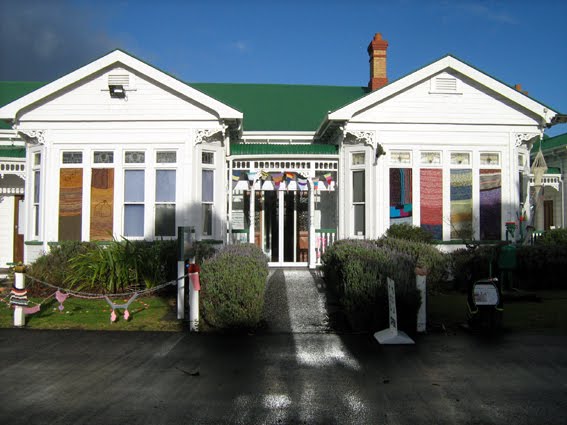
Alison Milne reports back on World Wide Knit in Public Day at CEAC

I think it was because I took a spare brolly, change of clothes and a towel, that the forecast wet did not eventuate until after the last window went up!

Saturday 12 June was fun... mostly, we didn't have time to knit on the day, although Liz wandered around doing her bit (on our behalf) for the World Wide Knit in Public Day.

We covered a lot of 'out the front' of CEAC - goodness knows what else we could have done if we planned it! Bernie and Donna included us in their photographic essay of the day, and we did have bemused visitors snapping away too.

Thanks so much to Judy, Kara, Sandra, Lyn, Maureen, Chris, Karen, Maxine, Glen, Marlynne, Tom as we have knitted and crocheted our graffiti since February. And thanks to Martin and CEAC staff for encouragement....and trust that we wouldn't be 'inappropriate'!!

We don't intend stopping now, and have a new project in mind. So, if anyone out there would like to join us, in our respectful disrespectful use of 'soft' graffiti in public spaces, please turn up to the CEAC Meeting Room on alternate Fridays (starting June 18) 9.30am-12.30pm.

Alison